
Common SEO Challenges in Single-Page Applications and How to Fix Them


Table of Contents
Key Takeaways:
● SPA websites have a different set of challenges while making it technically SEO-proof.
● Some of the issues with SPA are content invisibility, URL indexation, and duplicate meta tags across routes.
● It takes server-side rendering and dynamic meta management to tackle challenges for SEO for single-page applications.
So the entire complexity of an SPA website started to accumulate when, in March 2024, the FID was shifted to INP as a core web vitals. In the back end, the SPA is handling large JavaScript files, which take a lot of time to load and affect the SEO ranking.
And this is just the introduction of what common SEO for single-page application challenges SPA websites have to deal with.
SEO Challenges for Single-Page Applications
What we just talked about was one of the major concerns that the majority of businesses operating SPA websites deal with. Some of the extensive range of problems lies within.
The server sends a very slim (mostly a div with an id “app” and a JavaScript bundle) HTML shell. The actual content is created dynamically via JavaScript in the browser after the initial load.
When interacted with the site users won’t feel anything odd or face missing content. It presents an issue for the search engine’s crawler, as they have to run JavaScript and wait for it to finish in order to view the content that the page actually contains.
Google’s crawler is able to render JavaScript, but does so in a second wave that can take days, weeks, or longer after initial crawling.
Other search engines such as Bing have less powerful JavaScript capabilities. The consequence of this is that to make a single-page application and SEO compatible you have to do some work on it, not assuming that a crawler is going to do it for you.
This takes us to the first issue with SPA.
Challenge 1: Content Invisibility
Content invisibility is the most basic single-page application and SEO challenge. If a crawler visits a page in a JavaScript-rendered SPA, it can sometimes get the page’s HTML shell before the JavaScript has been executed, thus presenting the page as blank or virtually empty in the eyes of the crawler. The JavaScript that doesn’t get rendered or rendered incompletely by the crawler is not indexed on the page.
This impacts key on-page SEO components such as title tags, meta descriptions, heading structure, image alt text, and internal linking, all of which can be dynamically generated on the fly using JavaScript and not included in the original HTML response.
Challenge 2: URL Indexation
Usually, navigation is handled by client-side routing; that is, JavaScript changes the URL in the address bar of the browser and switches the content without calling the server again. User viewing them from a user’s perspective is navigating between pages. Technically, only one real page request occurred, which was the initial request.
This presents two issues with regard to SEO. If the server is not set up in such a way that it can serve URLs that request a deep link (e.g., yoursite.com/products/item-name) directly, then the user or crawler will receive a 404 error, since the server doesn’t have a file at that path.
Second, if all the routes are not individual, crawlable URLs, then search engines are unable to index individual pages within the application. Content that is located at dynamically rendered routes which are not discoverable via regular crawling won’t show up in search results.
Challenge 3: Thin or Duplicate Meta Tags Across Routes
The title tag and meta description of a traditional website are embedded in each HTML file. In a SPA, each HTML page is the same for each route, so, if left unmanaged, each page of the application has the same meta tags. Search engines see this as duplicate content on a massive scale, reduces the targeting capability of individual pages, and indicates a lack of quality search engine optimization practices.
Solution to Tackle These Underlying SEO Challenges
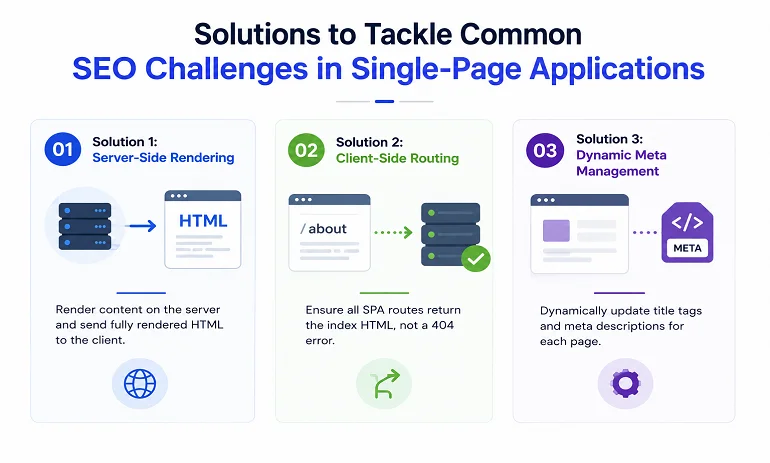
These underlying problem surely creates an issue with site ranking and overall online visibility. So how can SPA developers fix these technical aspects?
Solution 1: Server-Side Rendering
The best approach is to remote the content rendering to the server side; clients only run JavaScript and get full HTML with the page’s actual content.
Solution 2: Client-Side Routing
All SPA routes should return the application’s index HTML, not a 404 response that is generated by the server configuration.
This involves setting up mod_rewrite rules. The try_files directive does this in Nginx. For cloud hosting sites and CDNs, redirect rules do the same.
All the URLs in the SPA should return content, not an error, to both the crawlers and directly accessing users. In order to make SEO for single-page applications work at the route level, each route must have a unique, descriptive URL structure as well.
Solution 3: Dynamic Meta Management
The title tag and meta description should be different for each of the pages in the application, and the keywords that they cover should relate to the content on the page.
This is achieved with client-side meta management libraries:
- React: React Helmet or React Helmet Async
- Vue: You could use Vue Meta or the nuxt.js built-in useHead composible.
- Angular: Angular’s built-in Meta and Title services
In order to automatically generate unique and accurate meta tags for dynamic pages (product pages, blog posts, user profiles, etc.) without manual intervention.
These meta tags should be output on the server side, not on the client side after being hydrated, when SSR is enabled, so that the crawlers get them the first time they encounter the site.
Conclusion
Getting curbed by these challenges is common during website development and technical SEO. All it takes is the right knowledge or partnering with a reliable single-page application and SEO development agency.
SPAs are known for its fast loading page and perfect adoption for e-commerce websites. Customer acquisition costs are lowered by 30-60% for SaaS and e-commerce SPAs when implementing the proper SEO best practices.
FAQS
Is there a need for a sitemap for a SPA?
Yes. Since each page of an SPA doesn’t rely on HTML files, the crawler cannot find routes through the classic file-based indexing.
Does client-side routing affect SEO?
It can, if not used properly. Google doesn’t recognize hash-based routing as a unique URL. HTML5 History API routing creates indexable and clean URLs with proper server configuration.
Is it possible to be indexed by Google when you have a single-page application?
Google is able to render JavaScript, but it does it in a secondary crawl wave that can take days or weeks. Those pages that are purely client-side rendered may be indexed late, incompletely, or not at all depending on your SPA.
Does a SPA’s internal pages pass the PageRank?
Yes, provided they are used as a standard HTML anchor tag!