Creating Digital Infrastructure for Long-Term Business Growth

Table of Contents
Key Takeaways:
- Digital infrastructure acts as a modern protocol that manages your operations and data management smartly.
- Customer software development services offer the right guidance to set up your future-proof digital infrastructure.
It’s not that the most successful companies in the digital marketplace have to be unique in the market.
They are the ones who have established the underlying digital infrastructure.
Offering robust platforms and capabilities that are the foundation of the digital economy and that accrue value with each user. A realm that can be established by custom software development services that is regarded as an essential foundation.
What Exactly is Digital Infrastructure?
Infrastructure isn’t completely a physical hardware system but a combination of servers and physical assets.
The combination of both facilitates management of data and access to hybrid technology.
It enables automation of operations, integration of multiple platforms, and secure management of data. Digital infrastructure comprises of:
- CRM system
- API and third-party integrations
- ERP software
- Cloud computing platforms
- Automation architecture
But the main challenge where the majority of businesses fail is the unplanned planning phase and absence of ownership.
So how can we fix it?
Let’s find out next!
The Pillars of Long-Term Digital Infrastructure
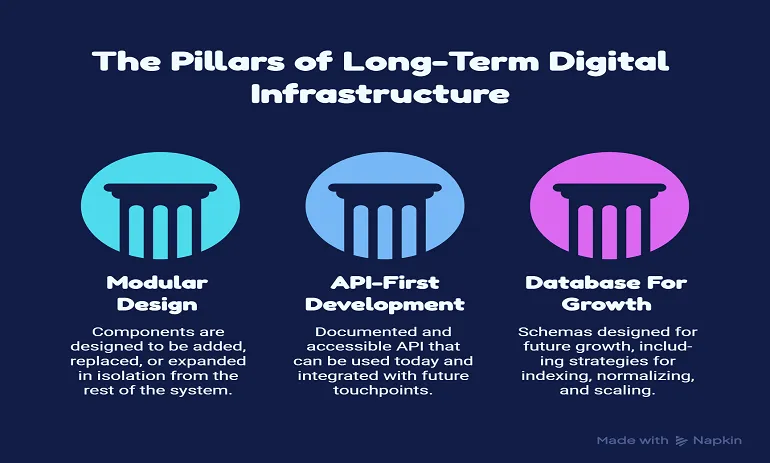
So basically, planning of durable and scalable digital infrastructure has been divided into three pillars.
Architecture that anticipates growth – Pillar 1
The most important infrastructure decisions take place before the first line of code is written.
What the business can build on top of the system for years to come is determined by the architecture.
It involves identifying how the system is structured, how the components communicate, how the data is organized, etc.
It’s about building for traffic that the business will have in a few years, in a way that doesn’t require a redo over the next few years.
This includes:
- Modular Design: Components are designed to be added, replaced, or expanded in isolation from the rest of the system; a tightly coupled system would require changing all the components if just one were changed
- API-First Development: Documented and accessible API that can be used today with the current web platform and free to be integrated with a mobile app, partner, or new customer touchpoint in the future
- Database For Growth: Schemas designed for future growth, with strategies for indexing, normalizing, and scaling, and decisions made in advance about how to accommodate larger, more complex query sets.
Data as Strategic Assets: Pillar 2
Not all businesses with the best products and the most aggressive marketing possess it.
They’re the ones who know how to take best decisions, provide more relevant experiences, and find more opportunities before others do.
This knowledge is based on data, and data infrastructure makes that knowledge accessible and actionable.
What data infrastructure offers:
- Customer behavior analytics, which includes understanding how customers move through digital touchpoints, where they drop off, what content they engage with, and what predicts purchase and retention.
- Product visibility of what sells, what doesn’t, and what demand patterns foretell the need for inventory.
- Understanding marketing attribution and knowing which touchpoints generate the most profitable customers. It enables efficient budget allocation to enhance the return on marketing investment in the long run.
- Accessing information that indicates where operational processes are inefficient, where operational errors are the most common, and where there would be the greatest cost saving from implementing automation.
Integration: Pillar 3
The typical growing business uses a set of tools in collaboration with custom software development services.
CRM from one vendor, an e-commerce solution from another, an accounting solution from a third, a customer support solution from a fourth. Both systems are effective when used separately.
When combined, this results in a business having the same data stored in multiple locations.
Now a problem arises with data moving around manually between systems, and often data that’s inconsistent, delayed, or incomplete.
To make it easier to manage, one of the biggest operational challenges in expanding companies is the integration gap, and one of the biggest competitive advantages is closing that gap.
Integration architecture helps an agency for website development to construct systems in which:
- When a customer reaches out to support, their purchase history, current order status, and account details will all be linked without having to search three systems by the support agent.
- An inventory update via the warehouse management system instantly appears on the e-commerce storefront, without a nightly sync job that could cause a moment of inaccuracy.
- When a new customer is added to the CRM, an onboarding email sequence is triggered. A task is added to the project management system, and a record is added in the billing platform without any member of the team having to take action on each of those items.
Conclusion
Digital infrastructure is the amplifier of all other investments in businesses.
When the web platform is reliable at converting sales leads, the marketing campaign reaches more customers.
Automated workflows enable operations to scale without proportionate increases in headcount.
Data infrastructure enables the making of improved decisions over time as the people making them have access to accurate and timely information.
If you’re ready to consider your digital presence as an infrastructure instead of a series of projects, the first step is to pick an agency for website development that has a forward-looking mindset.
Aim towards building a system that makes your business future-proof and a partnership from that core that will bring you greater value every year.
FAQS
What kind of businesses strictly require digital infrastructure?
Businesses of every size can benefit from digital infrastructure, but specifically industries like e-commerce, healthcare, and finance would benefit more from robust digital infrastructure.
Why should I hire a development agency?
A professional agency provides a scalable and secure system that offers a long-term solution.
What are some noticeable benefits of digital infrastructure?
It offers a centralized system that makes operations more efficient and gives better data management. Slashing the repetitive tasks and errors and contributes to better outcomes.
What challenges are associated with digital infrastructure?
Some of the evident challenges with digital infrastructure include security compliance, interoperability, scalability, and addressing regulations.