Leveraging the Business Strategy of a Custom E-Commerce Solution

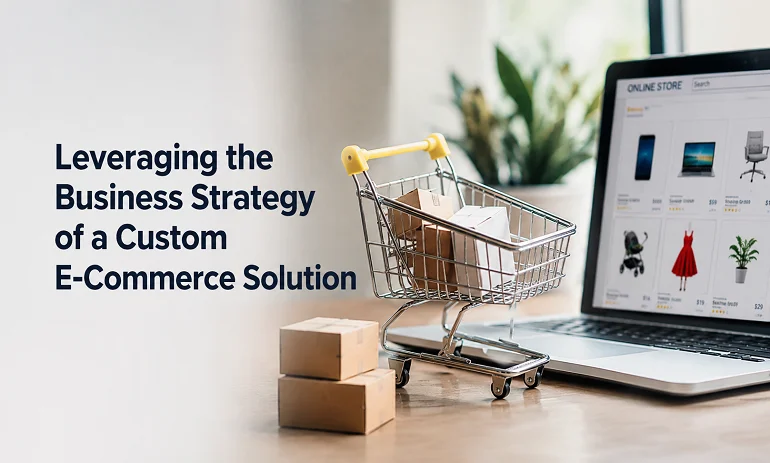
Table of Contents
Key Takeaways:
- A custom e-commerce solution is a well-planned strategy that aims to improve the shopping experience.
- It involves integrating AI, ML, AR, and VR capabilities.
- An e-commerce website that is built with custom capabilities offers dual benefits to consumers and entrepreneurs.
A personalized experience is the combination of a technological stack that includes AI, ML, AR/VR, and automation.
For many e-commerce platforms living under the rock, these technologies might sound far-fetched. And those entrepreneurs who are aware of this stack are really considering it just an option.
According to the report, six in ten retail companies planned to migrate to independent commerce platforms. Only 20% of them have made it through.
It reflects the huge gap in adoption of evolving technology and shows how foreign the concept of a custom e-commerce solution is. A custom e-commerce solution serves as the true arsenal for entrepreneurs.
What Does a Custom E-Commerce Solution Have to Offer?
91% of customers face an online shopping experience due to a lack of elusive experience, sourced by Netcore.
A custom strategy unlocks the capability to truly give an immersive experience. Sticking with an off-the-shelf template is all about presenting yourself as a generic brand.
You won’t be able to add a custom theme, template, advanced technology, or even do something innovative.
But with custom development solutions, the sky is the limit.
Custom e-commerce development provides:
- AI chatbox integration.
- Personalized search results with AI and ML.
- Virtual try-ons with AR and VR.
- Custom theme that aligns with your business identity.
- Robust and secure payment gateway.
- Predictive analytics and churn detection.
- Data ownership and complete CMS control.
Building the Strategy With Customization
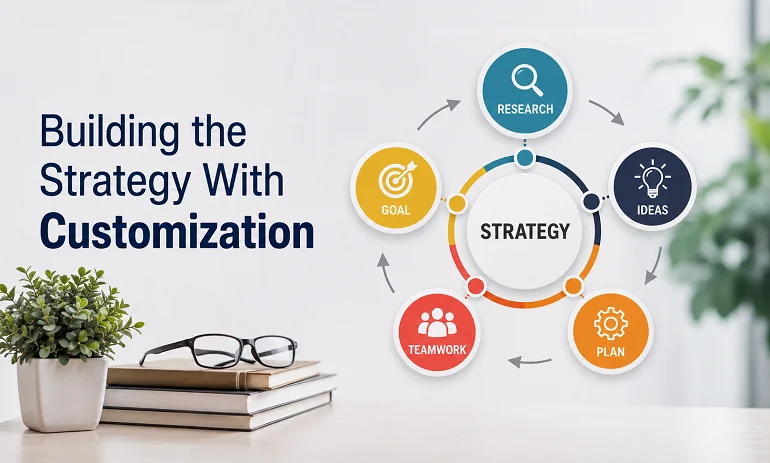
The implementation of technology in a manner that elevates the shopping experience is one way.
But what else can be capitalized on is creating stronger engagement. Something that industries at the pinnacle are leveraging: loyalty bonuses, additional checkout discount coupons, push notifications, and captivating campaigns.
There is an interwoven relationship between how you can customize your strategy with gathered data.
The data of customers stays with you, allowing you to truly understand what kind of customers and demographics are really landing on your site.
Now, when you really try to unravel it, the clear picture is presented, allowing you to tailor your campaigns, strategy, and product lineup accordingly.
In terms of e-commerce development. A custom solution doesn’t leave you stuck with a particular architecture.
Most of the pre-made e-commerce templates are developed with a monolithic architecture; it lets you switch from a monolith to a modular architecture.
Partnering With The Best Custom E-Commerce Development Solution
What integrations companies aims to include on the website?
How much is the organization willing to invest?
And is the development agency really equipped with the necessary resources?
Asking these questions ultimately resolves the selection for the best e-commerce solution for small businesses.
The roadmap to partnering and developing a custom solution is laid by having a clear vision first.
The development partner is as important as technology when it comes to creating a custom ecommerce solution that achieves the promise of personalization, performance, and long-term scalability.
RCV Technologies delivers the blend of expertise that custom e-commerce requires and most development agencies lack from one team:
- Tailoring the website’s design, optimizing performance on the front-end, designing back-end systems, writing APIs, and integrating with third-party gateways.
- Offering user insight and data expertise designing the recommendation engines, behavioral analytics layers, and dynamic pricing logic that turn a retail store into a personalization machine.
- Integration capability of AR/VR technology, enabling the use of product visualization, virtual try-on, and 3D product models to bridge the digital-real world divide in shopping experience.
- Scalable infrastructure planning – developing platforms that support growth in the business rather than the business as it currently exists.
Conclusion
AI-driven, AR-powered, personalized, and automated e-commerce is surely not a distant possibility.
It is the current competitive landscape of the fastest-growing companies in each industry.
The technology that powers AI, ML, AR/VR, and automation is not utopia, something that RCV Technologies has been able to forge and present functionally.
It’s available, it’s deployable, and with the right vision, it’s becoming more and more attainable to businesses of all sizes.
The investment in a custom ecommerce solution based on these features is not about the technology itself. It’s an investment in the customer experience, the operational efficiency that makes or breaks an e-commerce business, and whether it can grow or it’s left behind by the competition that was willing to invest in what customers truly want.
Whether it’s a small business or a growing enterprise, the trend for the best e-commerce solution for small businesses is one that’s designed for small businesses, not everyone.
FAQS
Is integrating AI a trend?
Integrating AI cannot be called a trend but a technological advancement that simplifies operations and experience.
What is a custom e-commerce solution all about?
A custom e-commerce solution is all about integrating personalized technology and experience rather than going with ready-made solutions.
How does a custom solution improve the shopping experience?
Custom solution integrations like AR/VR, personalized shopping, and AI chatbox make it quite an elevating experience for shoppers. Moreover, for someone arriving at your e-commerce site, they will get a unique navigation experience, something that might compel them to shop.
How long does it take to build a custom e-commerce platform?
It might take anywhere between 3 weeks and 6 weeks, depending on the requirements and upgrades demanded.