How Do SPAs Reduce Server Load and Improve Website Performance?

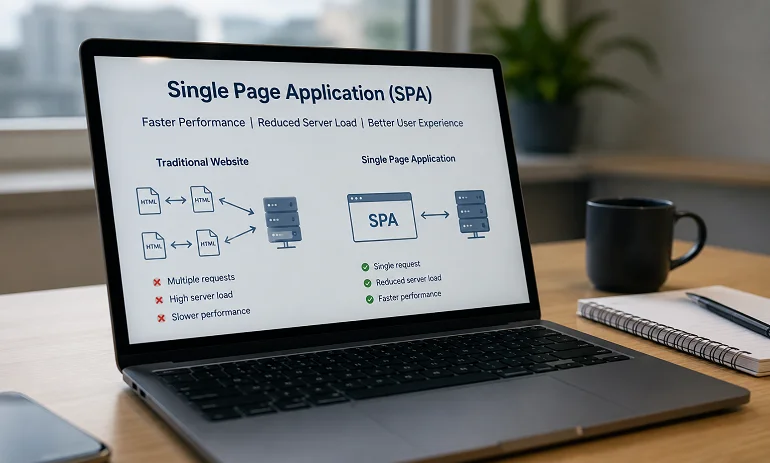
A single-page web applications (SPA) is known to exert less server load and process data faster, making it a viable stack for businesses. SPAs offer smoother data fetching that enables them to handle a large number of users.
Ever wondered how exactly SPAs are equipped to handle such meticulous performance requirements? The answer lies in their architecture, which we will be discussing in this article.
How Exactly Does an SPA Carry Out Fast Loading Speed?
The core resources of the application are loaded only once, and only data is loaded via APIs. It greatly reduces the number of calls to the server and hands-on interaction between client and backend systems.
It frees the server to perform essential tasks rather than focusing on repeated actions over and over for many requests. It will improve server efficiency and enable the application to serve more concurrent users with no performance loss.
Modern single-page application frameworks provide more complex features such as component-based, virtual DOM rendering, etc. These technologies are capable of rendering only the changed parts of pages, but not the whole thing. Therefore, it can avoid unnecessary processing and render more efficiently.
Caching speeds up the loading time by caching common resources in the browser, so that it does not need to be downloaded over and over again. And the transitions between pages are much faster, especially for those who frequently visit the pages.
User and Deployer Benefit of SPA
The main advantages of an SPA from a user’s perspective are speed and convenience.
Application is loaded once and updates the content dynamically without refreshing the entire page, which means users experience smoother navigation and faster interactions.
The key user benefits of this are:
- Instant Content and Data Loading: The primary benefit that users get to witness is that content and data load faster without any need to wait or refresh the page.
- No Delay Between Sub-Sections: In some cases, users face high waiting time. SPA’s have no delay moving between sub-sections with a fluid transition.
- Responsive User Experience: The architecture is created in such a way that it creates a mobile feel for the user.
- Minimized Data Fetch: Only the data needed is sent over the wire, which saves bandwidth.
- Consistent State: There is consistency in the state of the app throughout the whole app, which helps to remove the users’ frustration.
- Enhanced UX on Every Device: To offer a unified experience to users across all devices, including desktop, tablet, and smartphone, SPA is heavily leveraged.
Now let’s shed a light on the benefits that developers or businesses get. By availing SPA web development services for small businesses, application management and scaling are easier, and expect:
- Less Load on the Server: Only data that is requested is processed, not a full-page.
- Fast Development Cycles: There are faster development cycles with modern frameworks, and faster components that can be reused.
- Easy API Integration: APIs help the front-end and back-end systems to communicate with each other easily.
- Ease of Maintenance: Structured components allow for ease of update and bug fixes.
- Improved Performance Optimization: Lazy loading, Caching, and code splitting make performance more efficient.
- Opportunities for Cross-Platform Development: The same backend services can be leveraged to drive web, mobile, and third-party applications.
Best Practices in SPA to Amplify Its Performance
In a traditional website, whenever a request is made, there is repeated interaction that levies a heavy burden on the server. But in the case of an SPA, you can cache the DOM (Document Object Model), which reduces the overall processing time and improves performance.
Virtual DOM reconciliation and in-memory data management prevent unnecessary re-renders. React compares changes in the virtual DOM and updates only the components that have been affected, instead of updating the whole interface.
Similarly, there are several other best practices to incorporate:
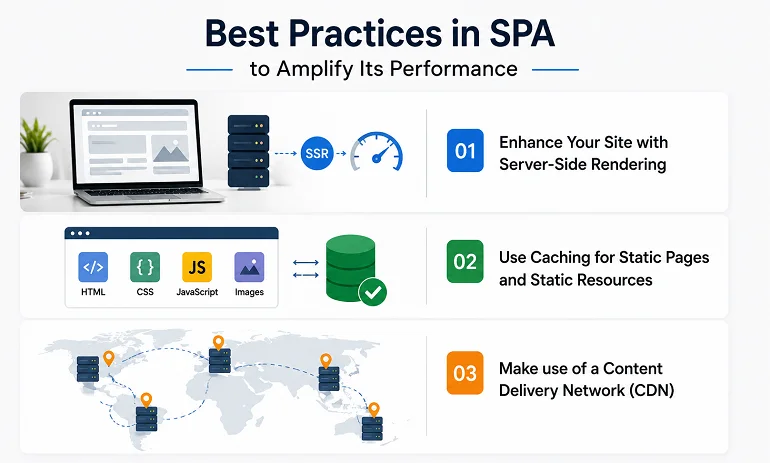
Enhance Your Site with Server-Side Rendering
Using server-side rendering to create dynamic, responsive webpages for visitors means that to create all of the initial page content from the server and send that content to the user’s web browser, before requiring any client-side JavaScript to load.
Ensuring that when the user initially loads the page, there will be valuable content immediately; therefore, this will result in a faster initial page load time.
Providing an enhanced mobile experience results in an improved search engine optimization (SEO) experience by giving search engine crawlers easier access to your site’s content.
Use Caching for Static Pages and Static Resources
Static resources (e.g. header, footer, images, CSS files, and JavaScript files) usually does not change often so by caching these resources in either the browser or application level, websites can serve these directly to the incoming requests without having to make a repeated request back to the server.
Less requests to the server means less load on the server, faster page rendering and a better experience for returning visitors.
Make use of a Content Delivery Network (CDN).
CDN can provide a network of website assets, distributed across different servers in different geographical areas. Content is served by the closest server, not the origin server, when accessing the application. This can greatly reduce latency, improve loading speed, reduce network congestion and provide consistent performance to people in different areas.
Final Verdict
The above-mentioned optimizations lead to a better user experience, better scalability, and overall better application performance. Generally, SPAs are great for SaaS platforms, enterprise portals, and other performance-intensive web solutions due to their robust handling of requests.
RCV Technologies SPA development services help develop highly scalable and performance-driven applications that can handle increasing user demands efficiently.
SPA is regarded as a great consideration for startups and should be on their cohesive list while availing web development services for small businesses.
FAQS
What is the biggest difference between SPA and MPA?
The biggest outlier between SPA and MPA is that SPA loads a single HTML page, whereas MPA loads a fully rendered HTML page.
What are some prime examples of SPA?
Gmail, Google Maps, Netflix, and Facebook are some of the prime examples of SPA.
Is SPA SEO friendly?
Yes, SPAs offer SEO-friendly technicalities but require additional considerations like pre-rendering issues and poor crawlability.
What are the benefits of investing in SPA?
From a business POV, they offer much more swift website application with lower maintenance costs. Ultimately, with a better navigation experience, conversions get boosted.