
How to Choose Between Node.js, Django, Laravel, and Spring Boot Server-Side Frameworks for Your Project?

Table of Contents
Key Takeaways:
- Choosing the framework should be based on the project type rather than opting for the popular ones.
- Each of the frameworks: Node.js, Django, Laravel, and Spring Boot offers different practical solutions and libraries.
There are an estimated 20-30 overall server-side frameworks, of which Node.js, Django, Laravel, and Spring Boot are the most adopted frameworks.
Speed, performance, scalability, and security all come down to what kind of framework you have adopted for your project.
There is no such thing as the best framework, as each of them is known to offer different functionalities and scope to developers. And this article will briefly discuss which framework befits your project.
Understanding Frameworks on the Server Side
The role of a server-side framework is to offer libraries, tools, and architecture to build a functional web application.
To simplify, a server-side framework refers to the back-end of a web application that manages how each execution will be performed.
A framework provides you with existing components that save and improve development time. The entire crux of development, maintenance, and the final product depends upon whether you aligned the right framework with the right project.
Why is it Important to Choose the Right Framework?
The reason why the majority of dependency is placed on choosing the right framework is that the core of the application revolves around it.
Using the wrong framework can lead to slow speed of execution, security issues, poor scalability, or costly redevelopment costing a lot in the future.
Certain criteria that must be considered before choosing the right framework:
- Security
- Application type
- Data load and management
- Budget and scalability
- Architecture type
- Community size
Organizations should base frameworks on project requirements, not on popularity.
Best for Real-Time Apps: Node.js
Node.js is a JavaScript runtime, not a framework, but one of the most popular backend technologies.
Node.js is famous for enabling persistent connectivity between the client and the server.
If you are running a business where you have thousands or even millions of users accessing your system at the same time, then Node.js is what you need.
Giving high performance and scalability to provide a good experience to the users.
Node.js is recommended for:
- Messaging and chat apps
- Live-streaming platforms
- Gaming online
- Tools for collaboration
Advantages
- Asynchronous and scalable architecture for efficient request processing.
- Excellent scalability for high-traffic applications.
- JavaScript, front-end and back-end, makes development so much easier
- A large, vibrant npm ecosystem with thousands of reusable packages.
- Great for building REST APIs and microservices.
- Fast development cycles, large community.
Security and Speed of Development: Django
Django is a high-level Python Web framework that encourages rapid development and clean, pragmatic design of secure and maintainable Web applications.
If you want Security, reliability, and fast development for your business, then Django is a great starting point.
It also features a clean architecture that helps in structured coding and also makes the application easy to maintain and scale.
Django is a popular choice for industries that deal with sensitive data or require a secure backend system.
Industries that are perfect are:
- Health care, education, and government
- Banking & Financial Technology
Advantages
One of the best features of Django is the administration panel, where businesses can manage users, products, content, reports, and operational data without having to create their own dashboards in the early stages of development.
Elegant Coding: Laravel
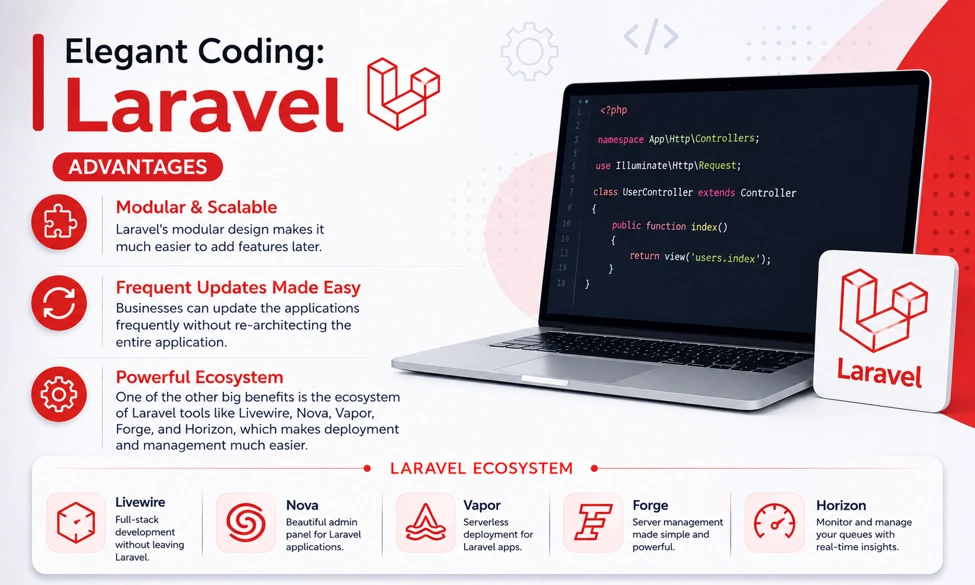
Laravel is the messiah in the modern PHP development world, a great example of power and elegance.
It helps developers to build complex business applications at a lower cost of maintenance and time to market.
Laravel allows businesses to easily develop the backend of their website and provides the flexibility to build anything from a small business website to a platform at enterprise level.
Laravel has some qualities that make it suitable for the following:
- Websites for ecommerce
- Customer Relationship Management systems
- ERP systems
Advantages
- Laravel’s modular design makes it much easier to add features later.
- Businesses can update the applications frequently without re-architecting the entire application.
- One of the other big benefits is the ecosystem of Laravel tools like Livewire, Nova, Vapor, Forge, and Horizon, which makes deployment and management much easier.
Spring Boot: Enterprise-Level Performance
Spring Boot is built on the Java Spring ecosystem, the platform of choice for enterprise software development.
This makes it easy to build secure and scalable Java applications that are enterprise-ready.
Large companies tend to prefer Spring Boot because of its high performance, especially where reliability and performance are important in high-volume environments.
Spring Boot is usually used for:
- Banking software
- Insurance platforms
- Enterprise SaaS offerings
- Logistics management
- Big e-commerce platforms
Advantages
Spring Boot integrates easily with cloud-based platforms like AWS, Azure, and Google Cloud, so it’s well suited for cloud-native enterprises.
Spring Boot does take a bit more planning to develop with than Laravel or Django, but it really is one of the best options for enterprise applications that will likely see a much longer lifespan.
Frameworks Comparison
| Basis | Node | Django | Laravel | Spring Boot |
| Achitecture | Event-driven | Model-view-template | Model-view-controller | Model-view-controller |
| Scalabilty | Horizontal | Modular | Modular | Very-high |
| Security | Moderate | Very-high | Better than Node.js | Very-high |
| Best Suited For | Real-time data fetching app | App that deals with complex data | E-commerce | Enterprise system |
| Cost of Development and Maintenance | Cost-effecient | Moderate | Moderate | High production and maintenance cost |
| Enterprises That Have Adopted | LinkedIn and Netflix | Instagram and Pinterest | BBC | Amazon and Google |
Wrapping Up
The framework decision is a technical decision, and there is no right or wrong answer to the server-side frameworks selection.
The companies and development teams that make the right decision are the ones who truly analyze it, based on the needs of the project, and not on the preference of the recommender itself.
If your business doesn’t have an in-house expert who can confidently make this judgment, then the best way to guide you through this decision is to have an experienced web development company in India that has been developing sites in multiple frameworks.
FAQS
Why do developers stick with Laravel?
Developers working with scalable projects prefer Laravel due to its scalability and clean, expressive coding.
Which framework would be the best fit for a small application?
Vue.js would be the preferred choice because it provides a faster deployment cycle and less setup.
Which framework offers easy AI integration?
Django is the strongest choice for AI integration. Due to the fact that it is built in Python, offering a vast AI ecosystem.
Which framework has lesser maintenance complexity?
Laravel and Django have easy maintenance capabilities.