Everything to Know About the Laravel AI SDK Package Launch in February 2026

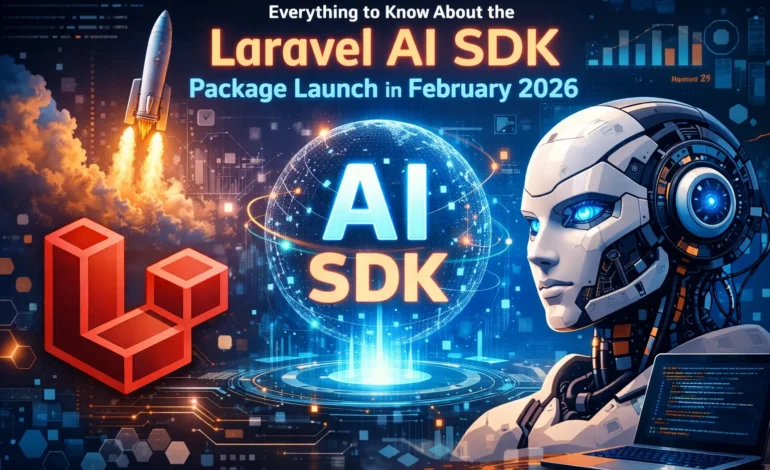
February 2026 marks a significant evolution in the form of diversifying the ecosystem. With the introduction of the AI SDK package and Agents, interacting with AI becomes more synthesizing.
Let’s take a deep dive into this expanded ecosystem and unravel the embedded features.
Significance and Newly Introduced Features
AI integration isn’t just following the trend, but a must-have framework that enables calculated actions. With the introduction of the AI SDK, the strive towards building an ecosystem is now in the palm of our hands.
It enables:
- Text generation
- Image generation
- AI providers (ChatGPT, Claude, Gemini, and so on)
- Tools and function calling
You can install the AI SDK with Composer
composer require laravel/ai
Next, you would be required to migrate the files using
php artisan vendor: publish –provider=”Laravel\Ai\AiServiceProvider.”
This should make the AI SDK functional, allowing you to run a database migration by
php artisan migrate
Then configure it by adding your personalized API Key that would fetch all the required data from the AI platform.
OPENAPI_API_KEY=
You can configure the rate limit and choose the endpoints accordingly. And the most exciting part is that you can create AI Agents that would interact with the dedicated PHP class that would reason, decide the next step, leverage the API, and execute multiple tasks.
You can also define a system prompt and an instruction allowing developers to maintain boundaries and focus on logic.
Conversation Trait
By using the Conversation trait, Laravel obtains a simple way to persist conversations without the conversation interface. This trait helps developers to:
- Respond naturally
- Maintain flow
- Recall past memory
When you prompt, you also have an option to add an attachment with the prompt to allow the model to inspect images or a document.
Tools
Tools give additional leverage to the AI Agent to interact with the application and services. Each tool contains a handle that can be utilized by developers to integrate:
- Query database
- Communicate with the external API
- Trigger application workflow
- Execute the queued job effectively
On the other hand, we also have the provider tool that is implemented natively, unlike regular tools. It holds the capabilities of web searching, URL fetching, and file searching.
Middleware
Now, Middleware can help developers intercept and modify the response, taking it as a layer that sits between the request passing and the controller. This adds controlling access to AI tools or agents and filters sensitive data.
Moreover, this adds a limit to how many AI requests a user can make to keep the system stable.
Image, Audio, and Transcription
Laravel\Ai\Image lets you set the aspect ratio and quality as well. This makes it easier for developers to create visuals inside the application.
Generated images can also be easily stored to config/filesystems.php, and can also be queued.
In addition, an audio class can also be used to generate audio and choose male and female voices as well. Transition capabilities can also be leveraged in the same ecosystem.
Compared to the Pre-Existing AI Package
Before the official SDK, developers used to implement Prism, Neuron AI, and LarAgent. Prism acted as an abstraction layer, allowing developers to switch between an AI and a Laravel application.
LarAgent manages AI Agents and simplifies agent creation. And Neuron AI focuses more on an agent-based workflow that handles tasks and reasoning.
These packages haven’t lost their relevance, but with the official AI SDK, things are now more streamlined and organized. As a first-party, it naturally holds more significance and seamlessly aligns with Laravel’s infrastructure.
Neuron works a bit better in terms of workflow ability than chain agents and handles complex decision trees.
Early Stage Performance
Surely this implementation is in an early stage, and still, it holds a lot of potential to evolve throughout. Ecosystem patterns are still forming, and businesses need a system that can adapt and act accordingly.
Rather than tying your application to a single vendor, developers now have the ability to support multiple AI providers. This release is a big leap towards catering to the emerging needs of applications in an efficient manner.
Features such as
- Queing
- Middleware
- Scaling AI
- Conversation trait
Are already on a strong foundation to handle a large scale of AI, as the community of Laravel grows, their performance, improvements, and standardized patterns are expected.
Final Words
Practical use of AI in Laravel apps ranges from an automatic email responder, a smart admin dashboard, a code and data analyzer, and workflow automation. This first-party maintained SDK serves as a crucial inclusion to upscale your workflow.
With the launch of the AI SDK, make sure to take full advantage of it, and do comment below to share your opinions.