
What is RCV Core and How Exactly Does it Support Deployment?

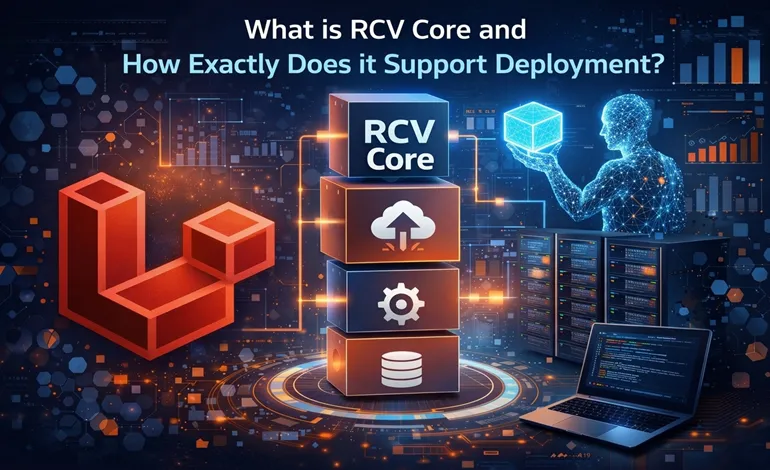
RCV Core is an open-source project for Laravel that facilitates a modular structure. This project boasts a clean and organized structure that combines the features of the service repository pattern and dynamic module management.
Modular Monolith: A Balanced Choice for Emerging Industries
RCV Core bridges the gap between the simplicity of monolithic and the complexity of microservices. It reduces the load on the infrastructure as the code gets segregated into more manageable modules.
With cache strategies, frequently accessed data is processed without increasing system load. Ensuring smooth scalability along with consistent performance.
Integrating a modular structure doesn’t really exhaust your resources like microservices and doesn’t remain inefficient like monolithic.
Moreover, with automated scaffolding, it removes the need to create a directory structure manually; the PHP namespace is created automatically.
And the best part in terms of the developers’ POV, is that it expedites the activate, deactivate, and update module without restarting the logic. It also helps developers by providing architectural assistance, anticipating what the next requirement would be.
Installation Guide: RCV Core
Your PHP version should be more than or equal to 8.0 to install the RCV Core package.
- To install
composer require rcv/core
- Then migrate the package by entering
php artisan vendor:publish –tag=core-module-migrations
- Run and create your first module
php artisan migrate
php artisan module:make UserManagement
- Finally, install your first module
php artisan module:marketplace install UserManagement
Architecture Overview
RCV Core is responsible for transforming a Laravel application into an organized, independent module.
The core components inside the RCV Core act into various definite pillars that avoid the cross-module chaos.
From handling incoming requests to processing business logic, instead of direct dependencies, modules communicate via events.
Moreover, the entire architecture is built upon the layer of host, core, and code.
The host layer that is the Laravel application consists of config, routes, views, migrations, service container, and events.
RCV Core package that is the second layer, extends and uses CoreService Provider, ModuleManager, ModuleRegistrationServices, Contract, Event, Commands, Events, Security, and MessageBus.
Then it registers and boots your module, each having routes, views, migrations, services, repositories, and models.
The ready-made structure of RCV Core has:
- module.json
- config.php
- Controllers to handle requests
- src/service that takes care of logic
- src/repositories for database
- src/routes that define how data will be accessed
- Models that act as a blueprint
- src/Events + src/Listeners to allow modules to communicate with each other without being tightly connected.
Furthermore, module.json enables developers to lay out the dependencies on a particular module due to the provision of a clean structure. The hassle of managing the dependencies from the core gets eliminated.
{
“name”: “UserManagement”,
“version”: “1.0.0”,
“enabled”: true,
“last_enabled_at”: “2025-10-29T10:42:26+00:00”,
“last_disabled_at”: null,
“applied_migrations”: [],
“failed_migrations”: [],
“dependencies”: [“kreait/firebase-php:^7.24”],
“dependents”: [“Core”, “Admin”],
“config”: []
}
Join the Community: Final Words
Modular offers a self-contained mini system that has its own logic, data, route, and communication that communicates independently. One module doesn’t really have to be tightly linked to another; they are just loosely coupled to support synchronization.
RCV Core is an open-source package where Laravel developers around the globe can leverage our structure. Visit the GitHub site and be a part of the project by making your invaluable contribution.